Category: Environment


DEC Coordinates Dolphin Rescue off Long Island
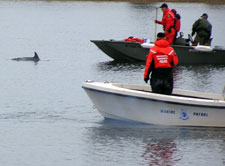
Because of our mild weather this winter, schools of migrating fish like mackerel and herring have uncharacteristically lingered in the North Atlantic. As a result, dolphins and whales off the tip of Long Island have been enjoying an extended fish smorgasbord. And residents of East Hampton on Long Island’s north shore were treated to a rare natural spectacle, a large pod of dolphins close to shore.

Exciting News
Crowds of people watched with delight as dozens of the gregarious sea mammals cavorted within a stone’s throw of the beach. News of them spread quickly, and local media reported on the phenomenon. The Riverhead Foundation for Marine Research and Preservation recorded the dolphins’ sounds with an underwater microphone, known as a hydrophone. Local grade school children on an impromptu field trip were enthralled listening to the clicks and squeals of the dolphins.
Change in Mood
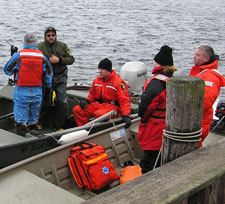
After a couple of days had passed, it became apparent that several of the dolphins were trapped by the tide in Northwest Creek, a shallow inlet. The mood quickly changed from one of celebration to one of alarm. DEC’s Region 1 Natural Resources Supervisor, Chuck Hamilton, was charged with organizing a rescue effort to free the dolphins before they stranded themselves in desperation. He subsequently contacted various federal, state and local government personnel, as well as volunteers and staff from the Riverhead Foundation.

Rescue Effort
Equipped with devices ranging from electronic pingers to steel pipes and hammers, boat crews created noise under water to drive the trapped animals out of the creek and into open water. According to Chuck, it was like “shoveling smoke.” All the commotion intended to free the dolphins also caused them distress, and rescuers had to be careful not to overdo it. Different dolphin species respond differently to the herding technique. These were common dolphins, which have smaller and more distinct markings than the bottlenose dolphins made famous on TV and at theme parks. Darkness and rough waters made it necessary to cease rescue attempts temporarily, providing an opportunity for the animals to calm down.

Mixed Results
Rescuers were able to free eight dolphins, but when operations were permanently suspended due to cold temperatures and high winds, three dolphins remained trapped and eventually died. Eight other dolphins had been confirmed dead, but necropsies (animal autopsies) failed to establish an exact cause of death.

Though disappointed by the deaths of some of the dolphins, Riverhead Foundation’s President, Chuck Bowman, said, “When dolphins become entrapped, rescue efforts hardly ever work. But we’ve at least been able to save eight of them, and I feel great about that.”

Editor’s Note: This story was compiled from DEC field reports and stories in Newsday and the East Hampton Star.

Water Efficiency Factoid

Replacing a pre-1994 toilet with a new high-efficiency model can reduce water used for toilets by at least 60 percent and save about 14 percent of total indoor water use. Savings for a typical household would be more than 10,000 gallons per year-enough to fill a backyard swimming pool!

More information about WaterSense: EPA

Go Eagles!

DEC Announces Results of 2006 Bald Eagle Breeding Season

The 2006 bald eagle population in has increased statewide from previous years and currently is at record numbers. Each year, DEC wildlife staff and volunteer “nest-watchers” monitor the nesting eagle population. Known nesting territories are monitored early in the spring to confirm returning adults, nest location, egg-laying date and the hatching of young. In addition, considerable time is spent trying to locate new nesting pairs in areas where adult eagles may have been seen regularly.

After active nests are identified, each site is visited to confirm the number of young produced; place a predator guard—an aluminum flashing to prevent raccoons from climbing nest trees and killing eggs or young—around each tree; band the young; inspect the nest for security and contents, and fix the location with a GPS device. The GPS information is instrumental because all locations are placed into the state’s Master Habitat Database, which is scanned thousands of times a year when development or other projects are being considered around the state.

Landowner Support
Because all nests are not on public lands, personal contact with the landowner is established to garner their support, as well as to discuss bald eagle biology and needs. Almost without exception, landowners are pleased and proud that they have eagles nesting on their land, and they are eager to help in any way they can. Landowners are the first, and best, line of defense in protecting the reestablished eagle population, which is why their support is so essential.

Record Numbers in 2006
During the first week of May 2006, nest visits began, and almost all nests had hatched. In the following two months, it was apparent that significantly more nests with three eaglets were encountered than ever before. By the time the final tally was completed in August 2006, a remarkable 172 young were counted as fledged from 110 nesting pairs in New York State during the 2006 breeding season.

These results mark a 20 percent increase in nesting pairs and a 54 percent increase in fledged young since 2005. Overall, 76 percent of all eagle pairs that nested in the state were successful in fledging young, with 30 percent of them producing three eaglets. The long-term average of nests with three eaglets is typically between 5-10 percent of all productive pairs. Biologists attribute the significant number of eaglets to very favorable mild and dry weather during the late winter and early spring when eagles were laying and hatching eggs, as well as to state and federal initiatives in place to protect these species. NYS DEC

Have a Water Efficient Holiday!

Preparing for and cleaning up after a holiday meal can use much more water than an everyday meal. Running your tap continuously while preparing food or washing dishes wastes water and can use more than 2 gallons of water every minute your tap is running. That’s a lot when you’re cooking a big meal for extended family members and friends! A few simple and easy steps can help save water and energy. If you own a dishwasher, scrape dirty dishes rather than pre-rinsing them before placing them in the dishwasher. If you don’t have a dishwasher, fill the sink with a few gallons of wash water, clean your dishes and put them aside. Then, rinse them all together at the end. Either of these simple practices could save 10 gallons. If every household reduced 10 gallons on Thanksgiving Day alone, it would save more than 1 billion gallons of water. That’s enough for 1 million households with dishwashers to wash their dishes for a year. For more information saving tips visit http://www.epa.gov/watersense/